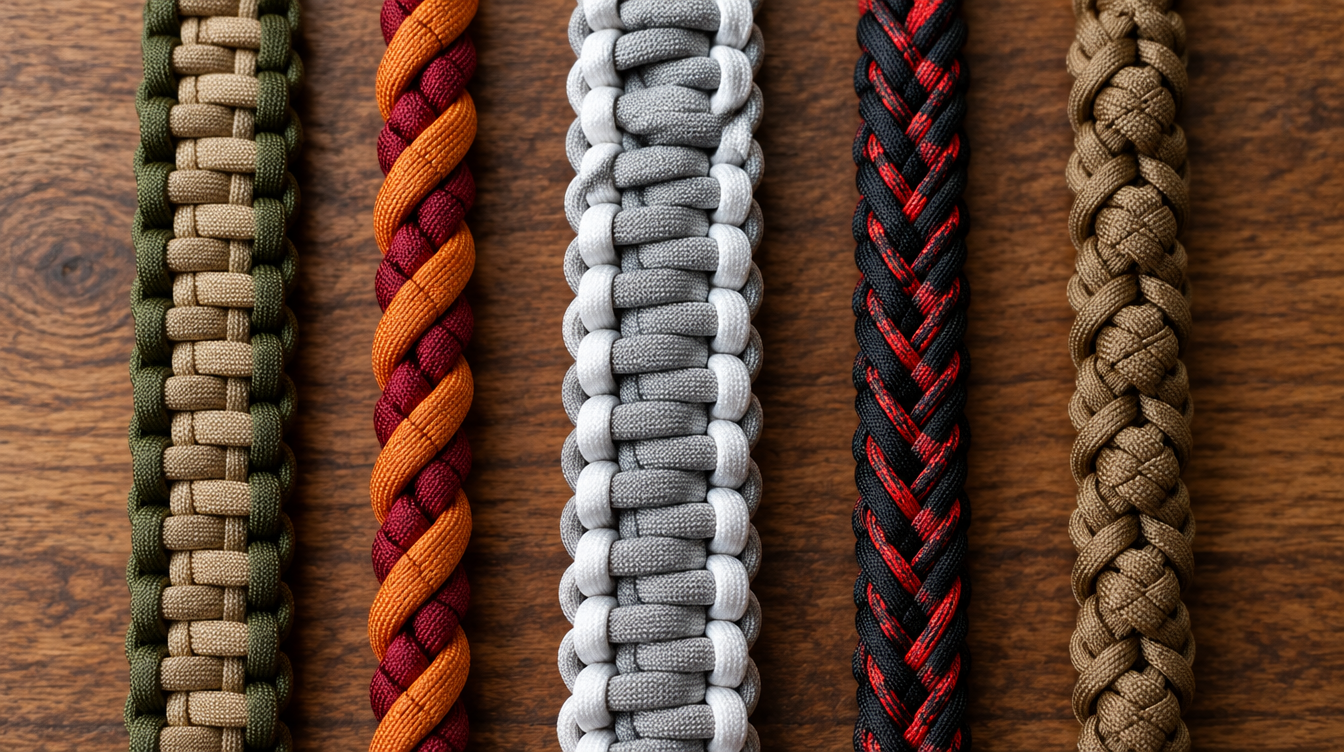

A paracord bracelet looks like a fashion piece. Undo it, and you’ve got real cord for a tarp line or a strap repair.
Paracord braid patterns aren’t all equal. Which braid you pick decides two things: how much cord you carry, and how fast you can get it back out. The section on how much cord a bracelet holds has the number to plan around.
At a Glance: Paracord Braid Patterns
- Start here: The Cobra is the easiest braid, and it’s the base for most bracelets.
- More cord: Doubled and layered braids, like the King Cobra, hold more cord in the same length.
- How much cord: Plan on about 1 foot of cord for every inch of a basic bracelet.
- Gear: You only need paracord, scissors and a lighter for your first one.
- Hardest: The Trilobite and the Monkey Fist take the most practice.
Survival Life earns a commission if you buy through the Amazon links on this page, at no extra cost to you. It doesn’t change what we recommend.
What do you need to start braiding paracord?
You need less than you think. For your first bracelet, grab paracord, sharp scissors and a lighter to melt the cut ends so they don’t fray.
Buy the cord first. A 100-foot spool of 550 cord covers about 10 bracelets, so you can practice a few patterns without running out.
Pick 550 cord in a color you like. This spool comes in over 250 colors, so you can mix 2 for a two-tone bracelet. It’s more cord than one project needs, which is the point while you practice. (paid link)

- Choose from over 250 different colors to fill your needs as each color is shipped on a 100 foot spool
- Diameter: 5/32” (About 4mm) with 7-strand inner core where each inner strand is made of 100% Nylon 2-ply yarns
Last update on 2026-10-28 / Affiliate links / Images from Amazon Product Advertising API
As an Amazon Associate, Survival Life earns from qualifying purchases.
After your first bracelet, a few small tools make the next ones easier:
- Buckles. A buckle turns a braid into a bracelet you can take off in a second. Look for 3/8-inch flat buckles made for bracelets.
- A braiding jig. It holds both ends tight, so your knots stay even. An adjustable paracord bracelet jig sets the length for you.
- A lacing needle. It pushes loose ends back through tight knots. A short stainless lacing needle fits on the cord end.
- A hot cutter. A lighter works fine for a few bracelets, but a hot blade cuts and seals in one step if you make a lot of them. An electric rope cutter is overkill for one bracelet, so wait until you need it.
Not sure which cord to buy? Our guide to types of paracord explains the differences.
Skip the tools until you’ve finished one bracelet by hand. If your knots come out uneven, that’s when a jig earns its spot.
The tool links above are paid links. As an Amazon Associate, Survival Life earns from qualifying purchases.
Which braids are easiest for beginners?
These 6 braids are the best place to start. Each one uses simple knots you repeat until the braid is long enough.
Cobra Knot

The Cobra Knot is the easiest and most common braid. You tie alternating half hitches around 2 center strands, and the result is a flat, flexible band. It’s also called the Solomon bar.
It’s the go-to braid for bracelets and dog collars. Learn this one first, and most other braids will feel familiar. Our step-by-step guide shows how to make a paracord bracelet with it.
Square Knot

The Square Knot, also called the Reef Knot, is one of the simplest knots there is. Tied over and over as a braid, it makes a repeating pattern of squares.
It’s great for friendship bracelets and zipper pulls. If you can tie your shoes, you can learn this one in an afternoon.
Snake Knot

The Snake Knot makes a tight, round braid that looks like a coiled snake. It’s popular for slim, simple bracelets.
Because it’s dense, it looks clean but takes a little longer to pull apart than a Cobra.
Viper Knot

The Viper Knot zigzags like a moving snake. It adds texture to key fobs and bracelets.
It’s simple enough for beginners. It’s better for light, decorative pieces than for heavy-duty gear.
Cross Knot

The Cross Knot uses 2 strands crossed in an X. You loop one strand over and under the other, then repeat with the second strand to finish each cross.
Keep going, and you get a chain of crosses. It works well on bracelets and lanyards.
Fishtail Knot

The Fishtail Knot looks like fish scales. You weave 2 strands over a center core to build the pattern.
It’s a good pick for bracelets and for straps on bags or camera slings.
That’s the beginner set. Once your Cobra is smooth, you’re ready for braids that hold more cord or take more care.
Which braids hold more cord or take more skill?
These 5 patterns are thicker or trickier. Most of them build on the Cobra.
King Cobra Knot

The King Cobra is a Cobra Knot tied over a finished Cobra Knot. The second layer makes it thicker and gives it a 3D look.
Because it’s 2 layers, it uses more cord than a single Cobra of the same length. That makes it a good choice for wide wristbands and tool handles.
Doubled Solomon Bar Knot

The Doubled Solomon Bar is a Cobra braid tied with doubled strands. It comes out wide and sturdy with a good grip.
Use it for belts and rifle slings where you want strength and a firm hold.
Trilobite Knot

The Trilobite Knot looks like the shell of a trilobite fossil. It’s a striking braid for knife handle wraps and walking sticks.
It takes precision, so save it until you’re comfortable with the Cobra.
Dragon’s Tongue Knot

The Dragon’s Tongue makes a raised, textured braid that looks like dragon scales. It’s built from Cobra knots with extra weaving.
It’s not the hardest braid, but it takes attention to detail. Try it on a keychain or a belt once you have a few bracelets done.
Monkey Fist Knot

The Monkey Fist is a round knot, not a flat braid. Sailors once tied it on the end of a throwing line. Today it’s used for keychains and lanyards, often tied around a marble or a small ball for weight. Our paracord keychains post has more ideas.
It’s dense and takes patience, so it’s best for experienced crafters.
How much cord does a paracord bracelet hold?
Plan on about 1 foot of cord for every inch of bracelet when you’re making a basic one, according to this paracord bracelet guide. So a 7 to 8 inch bracelet holds about 7 to 8 feet of cord.
That’s useful, but it’s not a lot. It’s enough to fix a strap or hang a small tarp line. It won’t replace a full hank of cord in your pack.
Layered braids, like the King Cobra, hold more because they use 2 layers. Measure the cord before you start, and you’ll know what you’re carrying. For the bigger picture, read everything you need to know about paracord.
Common mistakes with paracord braid patterns
- Pulling knots too tight on one side. The braid curves. Keep the same pull on both sides, or use a jig.
- Not sealing the ends. Cut ends fray fast. Melt them with a lighter and press them flat while they’re warm, being careful not to touch the hot plastic.
- Starting with a hard pattern. A Trilobite as your first project usually ends in frustration. Learn the Cobra first.
- Guessing the length. A bracelet that’s too short won’t close. Measure your wrist and add the buckle before you cut.
- Counting on more cord than you have. A basic bracelet holds about 1 foot per inch. Don’t plan around 20 feet you aren’t carrying.
Paracord braid FAQ
Paracord braid patterns are ways of weaving cord into bracelets or straps. You can undo the braid later and use the cord when you need it.
The Cobra Knot. It’s the easiest braid to learn, and many other braids, like the King Cobra, build on it.
Plan on about 1 foot of cord for every inch of a basic bracelet. A 7 to 8 inch bracelet holds about 7 to 8 feet. Layered braids hold more.
They let you carry strong cord all day without thinking about it. You can undo the braid to tie down gear or rig a tarp line.
Paracord, scissors and a lighter to seal the ends. A jig or buckles make later projects easier but aren’t needed to start.
Do one thing today
Cut 10 feet of paracord and tie a Cobra Knot bracelet tonight. It’s the base for most paracord braid patterns, so it pays off fast. Wear it for a week, and you’ll learn more than any guide can teach.
Where do you keep extra cord on a normal day?
A braided bracelet keeps cord on you all day. But a tight weave is slow to undo, and it only holds a few feet. A loose bundle in a bag is fast to use, but it’s easy to leave at home.
Have you ever unraveled a braid to use the cord? What happened? Tell us in the comments.
Disclaimer: All content on this site is for informational purposes only. Please read our full disclaimer here.