
To answer this, first we should find out how much energy 2012 DA14 could release if it crashed into our planet. According to Denton Ebel—Chair of the Division of Physical Sciences and Curator of the Department of Earth and Planetary Sciences at the American Museum of Natural History—three other scientists asked themselves this question in 2010: Robert Marcus, H. Jay Melosh, and Gareth Collins.
Ebel says that Marcus et al calculated the kinetic energy of a 50-meter-wide asteroid with a density of 2.6 grams per cubic centimeter and a speed of 12.7 kilometers per second hitting Earth at a 45 degree angle. This would be a similar scenario to 2012 DA14, which is only five meters smaller and, in the opinion of Ebel, “could have a density of about 2.6 grams per cubic centimeter” since it is a stony asteroid too.
Marcus, Melosh and Collins’ calculations resulted in 3.3 Megatons of kinetic energy at entry, with an airburst energy of 2.9 Megatons at about 8.5 kilometers from the surface, “about the cruise altitude of passenger jets.”
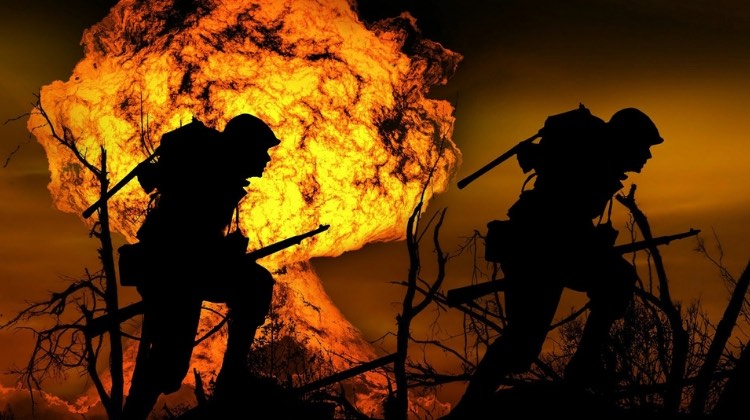
This means that an asteroid like this would likely explode in the air, releasing the energy equivalent of about 138 atomic bombs like the one that the Boeing B-29 Superfortress Enola Gay dropped over Hiroshima on August 6, 1945. Or, if you would like a more modern equivalent, 2012 DA14 could have exploded with the energy of nine W87 nuclear warheads like the ones carried by the American Minuteman III intercontinental ballistic missiles.
If the magnitude of such an explosion is hard to imagine, take a look at this Chinese 3.3-Megaton atomic bomb test:
[youtube id=”YW3FBN2zfdk” width=”620″ height=”360″]
Not too shabby.
Needless to say, the effects of such an explosion over New York, San Francisco, London, Madrid, Moscow, Rio de Janeiro, Sydney, Beijing or Tokyo, would be quite significant.
But—BUT! thankfully there is a but—fear not: Ebel says that, while “direct hits are bad, these cities are very small targets.” So even if 2012 DA14 were to impact Earth, the probabilities of a direct hit like the one described above would be very, very thin.
But what if we were really, really unlucky?