
Everyone in your house will look at you when the tap runs dry, and a filter by itself is not a plan. The question that decides everything is not which filter is best. It is where your water will actually come from, and what has to happen to it before anyone drinks.
At a Glance: Survival Water Filters for 2026
- Bugging in, for volume: Waterdrop gravity system, plus a disinfection step for untreated sources
- Bugging out, light and fast: Sawyer MINI, 0.1 micron, up to 100,000 gallons
- Urban disasters, virus risk: Survivor Filter PRO, 0.01 micron final stage
- Muddy water and groups: Katadyn Hiker Pro, 0.2 micron, about 1 L/min
- Cheap backup: LifeStraw Personal, 0.2 micron, 2.1 L/min
Survival Life earns a commission if you buy through the Amazon links on this page, at no extra cost to you. It doesn’t change what we recommend or the order we recommend it in, and the cheapest option gets the same attention as the most expensive.
Where your water will actually come from
Almost every household water emergency comes from one of three sources, each needing a different response.
The first is the water you already stored. It needs nothing done to it, which is why it is the only source that works while you are still figuring out what happened.
The second is municipal water under a boil order. The plant is still delivering, but the water needs heat before it is safe, and our boil water advisory checklist covers what to use it for meanwhile.
The third is untreated surface water: a creek, a pond, a rain barrel, standing floodwater. This is the only one where a filter does the heavy lifting, and there are several ways to treat it besides filtration.
Gear marketing inverts that ranking. The filter aisle is built around the third scenario, while most households get hit by the first two.
The three-stage water plan
Most people buy the filter first and the water plan never. Flip that order and the spending shrinks.
Stage one
$0–40
Store water, learn to boil
One gallon per person per day, 72 hours minimum, food-grade containers out of direct sunlight. Rolling boil for 1 minute, 3 minutes above 6,500 feet. Our long-term water storage guide covers containers and rotation.
Stage two
$20–90
One filter, matched to your source
Buy for the water you are most likely to face, not the most dramatic one you can imagine. A household with a creek nearby buys differently than an apartment on the ninth floor.
Stage three
$100–250
Volume and redundancy
Add family volume and a second unit, because a filter fails silently. Our home filter builds cover the parts if you would rather build than buy.
Do not skip to stage three. A household with a $200 counter-top system and no stored water is less prepared than one with six cases of bottled water and a pot.
Each pick lists what the manufacturer publishes. Where a figure is not published, this guide says so rather than inventing one.
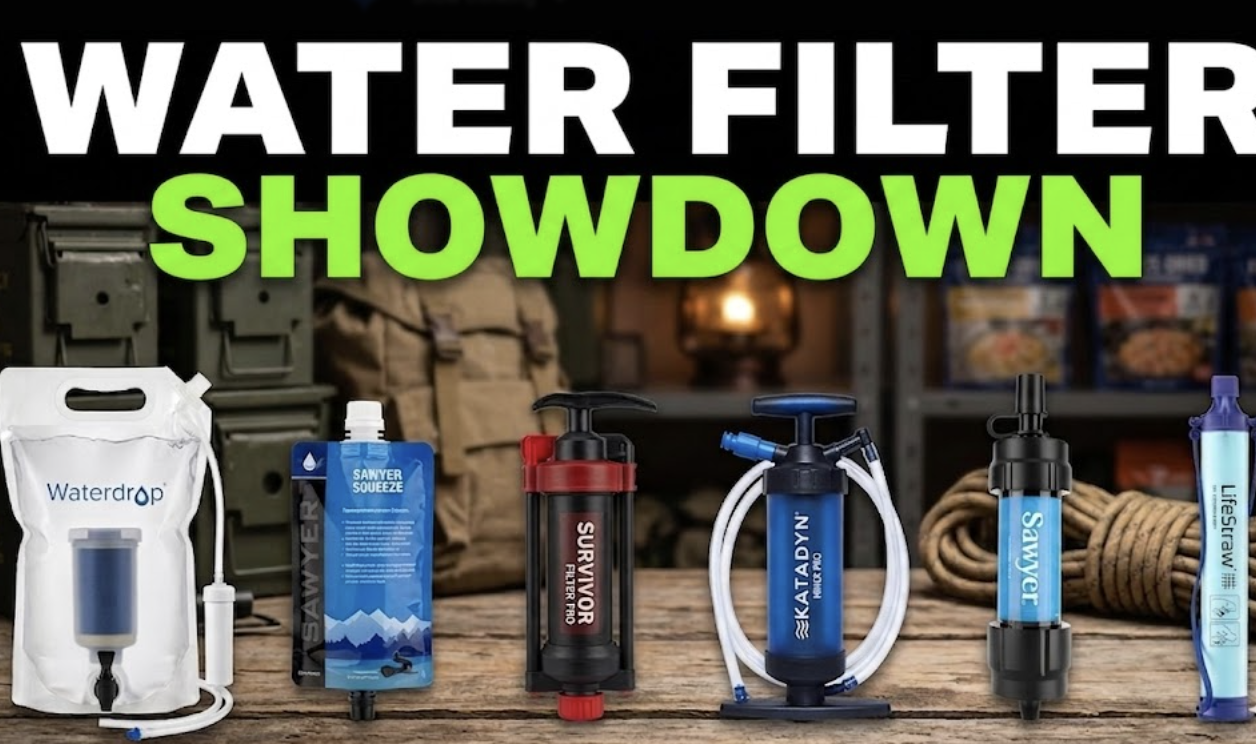
Waterdrop Gravity Water Filter System: best for bugging in

When taps fail for days, the problem stops being purity and becomes volume. A gravity system passively pulls water through carbon and membrane elements into a lower reservoir, so a family gets a steady supply without anyone spending the afternoon on a hand pump.
Whatever gravity system you choose, check its certification before you rely on it. A unit certified only to NSF/ANSI 42 and 372 is rated for taste, odor, and lead-free materials, not for pathogens. Boil or chemically disinfect any untreated source first, then run it through for taste and sediment.
Pros
- Zero physical labor to operate.
- High volume capacity for families.
Cons
- Extremely bulky; it cannot be used for bugging out.
- High upfront cost.
Sawyer MINI: best for bugging out

Evacuating on foot rewards anything that weighs two ounces and screws onto a bottle you own. The MINI uses a 0.1 micron absolute hollow fiber membrane, which Sawyer rates for up to 100,000 gallons, with stated removal of 99.99999% of bacteria and 99.9999% of protozoa.
Sawyer does not publish a single flow rate figure, noting that flow depends on how clean the filter is and on altitude. Anyone quoting you an exact number for this filter is quoting something other than the manufacturer.
The failure mode is freezing. Water trapped in the fibers expands and cracks them, and the filter looks normal afterward while passing bacteria through. Keep it inside your jacket in winter.
Pros
- Ultra-lightweight and packable.
- Rated to 100,000 gallons with regular backflushing.
- Modular (screws onto standard water bottles).
Cons
- Ruined instantly if frozen.
- Requires frequent backflushing to prevent clogs.
Survivor Filter PRO: best for urban disaster risk

Urban water carries what wilderness water does not: sewage-borne viruses, heavy metals, and industrial runoff. Standard camping filters give false confidence here, because they are built for wilderness bacteria. The PRO’s stack finishes at 0.01 micron, an order of magnitude tighter.
The manufacturer states its filters are tested in the USA to NSF/ANSI standards for bacteria, parasites, and virus reduction to 99.999%, with significant heavy metal reduction. Note that the published 500 mL per minute flow figure appears on the battery-powered PRO X, not the manual pump reviewed here, so treat pump speed as unstated.
Even at 0.01 micron, keep disinfection tablets with it. A tighter pore does not change the rule on viruses, and floodwater is where that costs you.
Pros
- 0.01 micron final stage, the tightest here.
- Carbon stages reduce heavy metals and chemicals.
Cons
- Slow going for family-sized volume.
- Requires manual pump action.
Katadyn Hiker Pro: best for muddy or stagnant sources

Sediment is what kills filters in the field. The Hiker Pro puts a pre-filter screen on an intake hose, so the hose drops into a muddy source and grit stops before it reaches the element.
Katadyn publishes a 0.2 micron glassfiber pore size, a flow rate of approximately 1 liter per minute, cartridge life up to 1,150 liters or 300 gallons depending on water quality, and a weight of 310 grams.
That 300 gallon cartridge life is the shortest here by a wide margin, the honest tradeoff for pumping dirty water without destroying the unit.
Pros
- Intake hose allows pumping from shallow puddles.
- Pre-filter protects the main element from mud.
Cons
- Bulkier than a squeeze filter.
- Shortest cartridge life here at about 300 gallons.
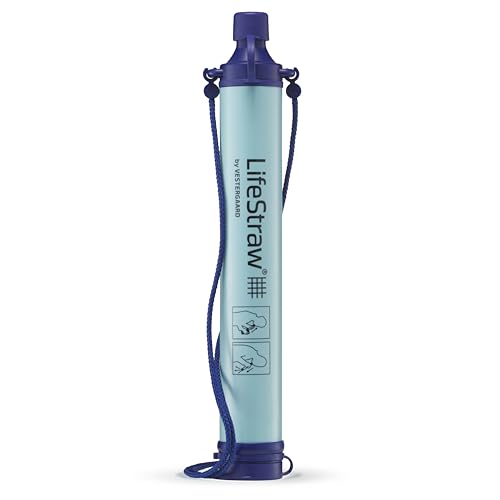
LifeStraw Personal: best cheap backup

The case for the LifeStraw is that it requires nothing: no pump, no syringe, no bottle threads, no learning curve at the worst moment. At roughly $15 to $20 it is what you stash in a glovebox or a cache tube and forget about.
LifeStraw publishes a 0.2 micron membrane microfilter, a flow rate of 2.1 liters per minute plus or minus 30%, and a lifespan up to 4,000 liters or 1,000 gallons.
The limitation is ergonomic, not technical. You drink through it face down at the source, which makes it poor for filling containers or carrying water back to anyone else.
Pros
- No moving parts or attachments needed.
- Cheap enough to buy in bulk, with excellent shelf life.
Cons
- Forces the user to get face-down in the dirt to drink.
- Cannot easily filter water into a secondary container.
Published specifications, side by side
Portable filters
Every figure comes from the manufacturer’s own spec sheet, linked underneath.
| Filter | Pore size | Flow rate |
|---|---|---|
| Sawyer MINI | 0.1 micron absolute | Not published |
| Survivor Filter PRO | 0.01 micron final stage | Not published for the manual pump |
| Katadyn Hiker Pro | 0.2 micron glassfiber | About 1 L/min |
| LifeStraw Personal | 0.2 micron | 2.1 L/min, plus or minus 30% |
Filter life: Sawyer MINI up to 100,000 gallons, LifeStraw up to 1,000, Katadyn up to 300, Survivor Filter PRO 100,000 litres on the ultra stage and 2,000 on carbon. All four clear both pore-size thresholds above.
Sources: Sawyer, Survivor Filter, Katadyn, LifeStraw.


Last update on 2026-10-09 / Affiliate links / Images from Amazon Product Advertising API
Common mistakes
- Treating a taste filter as a pathogen filter. NSF/ANSI 42 covers chlorine and odor, not microbiology. Pitcher filters and many counter-top systems sit in this category.
- Buying gear before storing water. Stored water is the only source needing no equipment, no fuel, and no decisions while you are still reacting.
- Letting a hollow fiber filter freeze. It cracks internally, shows no external damage, and quietly stops working. One freeze means you replace it.
- Filtering virus-risk water and stopping there. Floodwater and sewage exposure call for a disinfection step after filtration, regardless of pore size.
- Running muddy water through an unprotected element. Pre-filter through cloth or use an intake screen, or you clog a $90 filter in an afternoon.
- Never using it before you need it. Backflush it and fill a container once, in your kitchen, while the instructions are still readable.
Frequently asked questions
No. Boiling kills bacteria, viruses, and parasites, but it removes nothing from the water. A rolling boil for 1 minute handles what is alive, or 3 minutes above 6,500 feet. Water with fuel or chemicals in it is a different problem that boiling does not fix, so that source gets replaced rather than treated.
The one matched to the water you are most likely to face. For stored or municipal water under an advisory, volume and taste matter most. For untreated surface water on foot, a 0.1 micron absolute filter like the Sawyer MINI covers bacteria and protozoa at two ounces. For urban flooding, choose a tighter multi-stage unit and carry disinfection tablets.
No, not as a category. Filters stop bacteria at 0.3 micron or smaller and parasites at 1 micron or smaller. A virus is smaller than both, so it passes straight through. Add chlorine dioxide drops to filtered water any time viruses are a risk.
The internal fibers crack and the filter stops working while still looking normal. A hollow fiber filter holds water inside its fibers after first use, and freezing expands that water. If a used hollow fiber filter freezes solid even once, replace it.
No. None of these filters remove salt. Boiling does not either. It steams off the water and leaves the salt behind, so what is left is saltier. Removing salt takes reverse osmosis or distillation, and drinking salt water speeds dehydration up.
The bottom line
If you are buying one filter, buy for your most likely source, not your most dramatic one. For most households that is a 0.1 or 0.2 micron unit under $40 plus disinfection tablets, sitting behind a shelf of stored water that handles the outage you will actually get.
If your risk is urban flooding, the multi-stage 0.01 micron option earns its price, and it still pairs with tablets. If your risk is a long grid-down stretch with a family to supply, a gravity system solves volume, as long as you disinfect untreated water before it goes in.
Do one thing today
Count the drinkable water in your house and divide it by the number of people living there. If that is under three days at one gallon per person per day, fixing it costs less than any filter here and matters more than all of them.
Quick poll
You’re down to two water sources during SHTF: the neighborhood pool, or rainwater off your gutters.
Which one are you filtering?
Either way, same sequence. Let the sediment settle, filter it, then disinfect it. And neither one beats the water you already stored.
Which one did you pick? Defend it below.