
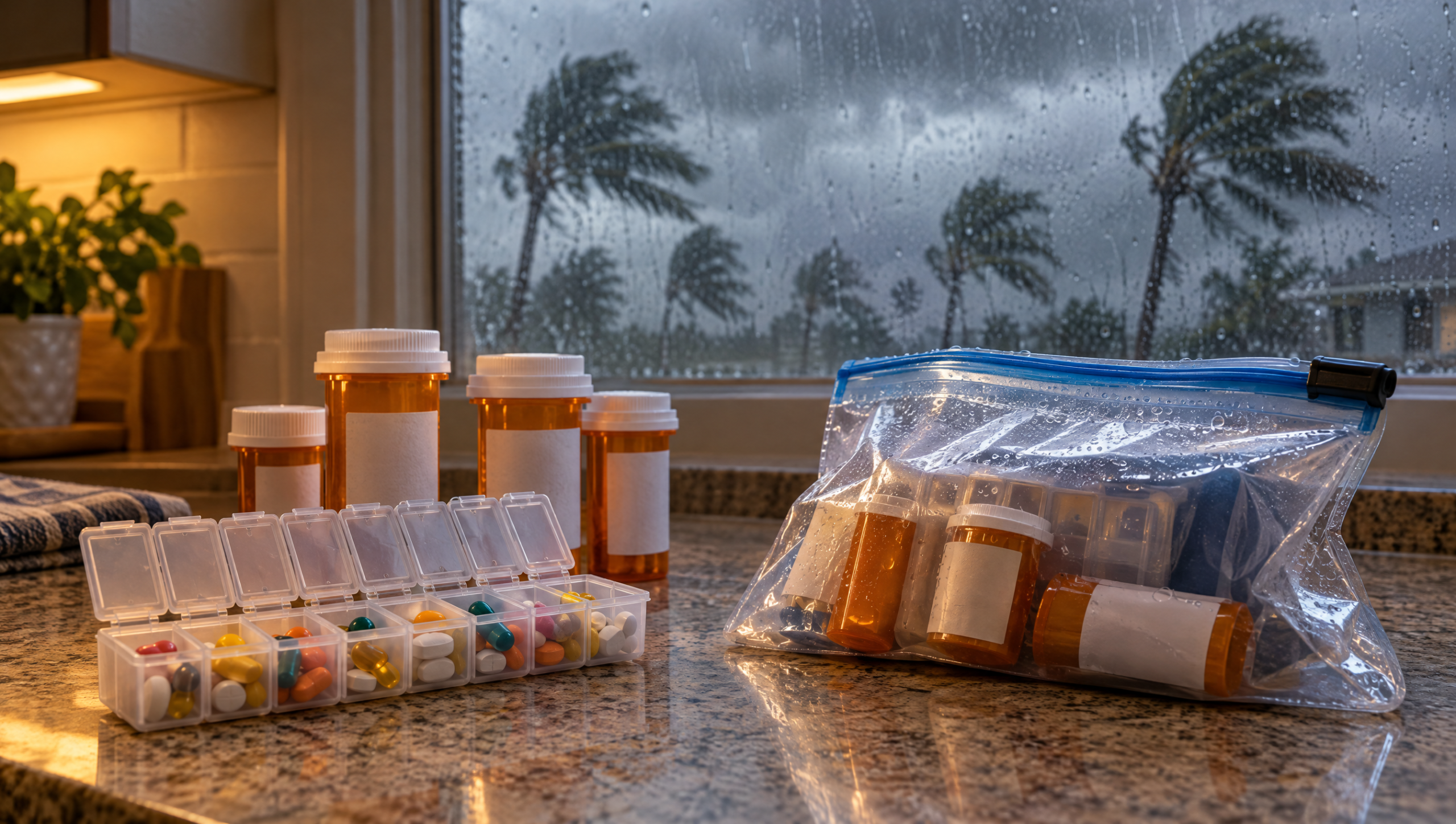

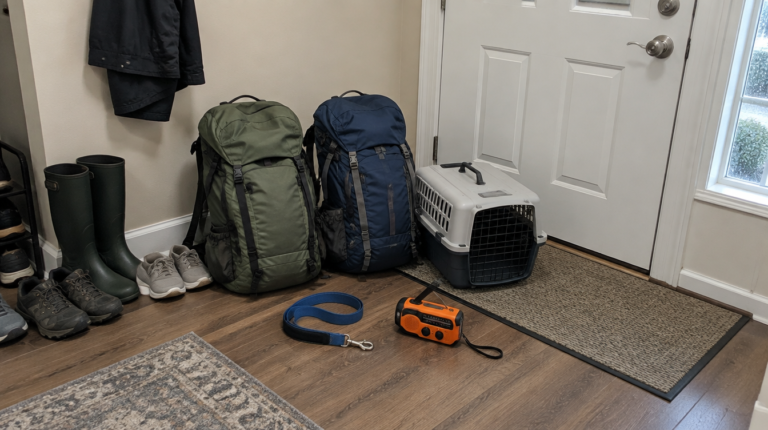
A hurricane go-bag holds three days of water, food, medication and documents for one person, in a pack that one adult can carry while soaked. Most families pack far more than that and then cannot lift it. The fix is not a longer checklist. It is deciding which layer each item belongs to before the storm has a name.
Your evacuation route sets your packing list, not the other way around. Map a primary route, an alternate, and a third you would take on foot. Then pack for the worst of those three.
At a Glance: Hurricane Go-Bag
- Water: One gallon per person per day. Carry the filter, not the water.
- Weight ceiling: No pack above 15% of the carrier’s body weight, loaded.
- Medication: A 30-day supply of every daily prescription, filled before the season.
- Three layers: Bulk stays home, sustainment stays in the vehicle, essentials go on your back.
- Pre-packed kits: Usable as a base bag. Never usable as delivered.
Survival Life earns a commission if you buy through the Amazon links on this page, at no extra cost to you. It doesn’t change what we recommend or the order we recommend it in, and the cheapest option gets the same attention as the most expensive.
What goes in a hurricane go-bag

Build around three layers. Bulk canned goods and stored water stay at the house. Sustainment for the drive, meaning a cooler, a case of food and several gallons of water, rides in the vehicle. The go-bag is the third layer, and it only earns its weight if you can walk away from the car wearing it.
That is the part most checklists skip. If the interstate locks up and you leave the vehicle, everything you keep is on your back. Ten categories cover it:
- Water filtration: A squeeze filter plus purification tablets as backup.
- Calorie-dense food: Bars or rations that need no cooking and no water to prepare.
- Shelter and warmth: A heavy-duty emergency bivvy. Thin foil blankets tear in wind.
- Fire: Stormproof matches and a butane lighter, in separate pockets.
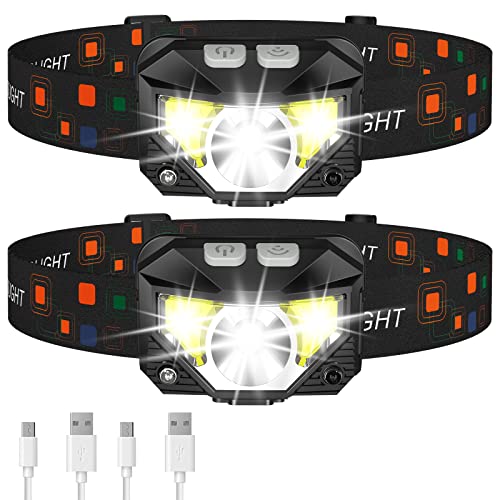
- Light: A headlamp, so both hands stay free for a child or debris.
- Power: One high-capacity power bank, charged, with its cables taped to it.
- Alerts: A battery-powered weather alert radio with a hand crank.
- Navigation: A paper map of all three routes, in a sealed bag.
- Medical: Daily prescriptions first, then a trauma kit with a tourniquet and pressure dressings.
- Sanitation: N95 masks, contractor bags, wet wipes.
Two of those ten are the ones families forget until it is dark and wet: the documents and the dry layer. Soaked IDs and a wet sleeping bag are what turn an inconvenient evacuation into a bad one.
![Don’t Die in The Woods – World’s Toughest Emergency Blankets [Orange]](https://m.media-amazon.com/images/I/51VPHGI9Q8L.jpg "The 2026 Hurricane Go-Bag Essential Items")

Last update on 2026-10-05 / Affiliate links / Images from Amazon Product Advertising API
The five things you grab on the way out the door
A go-bag is roughly 80% of an evacuation. The rest is what you cannot pack six months early, like this month’s prescriptions and the dog’s food. When the order comes you get a narrow window to collect them, so work a fixed order instead of improvising.
Evacuation order
Work top to bottom. The order is the point, not the list.
| Grab | What it covers | Why it sits here |
|---|---|---|
| People and pets | Everyone in the household, animals included | Life safety outranks everything. Property is replaceable. |
| Prescriptions | Daily medications, inhalers, insulin, glasses, device chargers | The gap that strands families is a missed refill, not a missing tourniquet. |
| Papers | IDs, insurance policies, deeds or leases, birth certificates, pet records | Claims and shelter intake both ask for them. |
| Personal needs | Clothes, cash in small bills, phone, toiletries, kids’ comfort items | Three days of function with no store and no ATM. |
| Priceless items | Photo drives, heirlooms, irreplaceable mementos | Last, deliberately. If time runs out, these stay. |
Photograph the papers now. A phone album of every document in that row costs ten minutes and survives a soaked folder.
Document list and the two-week medication window follow West Virginia University Extension, which recommends one gallon of water per person per day and medications for two or more weeks.
For a version you can hand to a spouse or a teenager, our printable family disaster plan template assigns each of the five to a named person.
Water, power and light that survive the storm
Stop packing bottled water. Run the arithmetic once and it settles the argument for good.
The water weight problem
One gallon per person per day, 72 hours, at 8.34 pounds per gallon.
| Household | 72-hour need | Weight of the water |
|---|---|---|
| 1 person | 3 gallons | 25 lb |
| 2 people | 6 gallons | 50 lb |
| 4 people | 12 gallons | 100 lb |
What breaks it: nobody walks a mile under 100 pounds of water. A squeeze filter weighs about two ounces and handles far more volume than you could carry.
Volume guidance from University of Florida IFAS Extension, which recommends one gallon per person per day for at least seven days as a home supply in a hurricane state.
That volume lives at the house. What you carry is the ability to make water drinkable.
Filtration

A hollow-fiber squeeze filter is the baseline. Sawyer publishes the MINI at 0.1 micron absolute, rated up to 100,000 gallons, removing 99.99999% of bacteria and 99.9999% of protozoa. At roughly two ounces in the field it replaces every bottle you were going to carry.
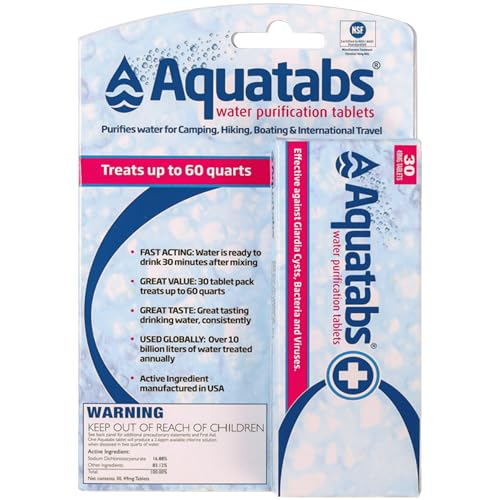
Carry tablets as the backup, because a filter can clog. Aquatabs states that one 49mg tablet treats up to 2 liters and needs a 30-minute wait before you drink. Thirty tablets weigh almost nothing and cover 60 liters.
One hard limit on both. Filters and tablets handle what is alive in water. Neither removes fuel, solvents or chemical runoff, and boiling makes that worse by concentrating it. Floodwater beside a fuel station or an industrial lot is not a water source at any price, and our guide to emergency water purification methods covers which method matches which contamination.
Power

A cheap solar novelty bank needs most of a week of direct sun to fill a phone once, and you will be under cloud cover. Buy capacity you can verify instead. Look for LiFePO4 cells, meaning lithium iron phosphate, a battery chemistry that tolerates heat and survives far more charge cycles than standard lithium-ion.
Size it to the job. A phone battery holds roughly 4,000mAh, so a 15,000mAh bank is about three full charges once you allow for conversion losses. That is a realistic 72 hours of coordination, not a week of entertainment.
Light

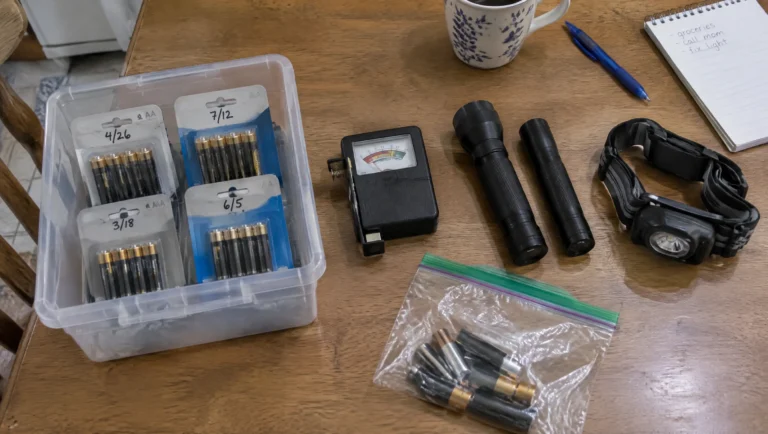
Standardize your batteries. If the headlamp takes AA, buy a weather radio that takes AA, and carry one pack that feeds both. Mixed chemistries are how people end up with dead gear and a bag full of the wrong spares.
Choose a headlamp over a handheld light. In moving water or on a debris-covered street, both hands are already busy.


Last update on 2026-10-05 / Affiliate links / Images from Amazon Product Advertising API
What a pre-packed kit actually costs you
Search volume says people want to buy the problem away, and the kits are built for that impulse. Most are assembled to a price, not to a family. They go in heavy with water pouches and cheap plastic lights, which wrecks the weight-to-speed ratio you need in gridlock. A 45-pound bag with zippers that fail in the first mile is worse than no bag, because you trusted it.
That does not make every kit useless. It makes the kit a base, not an answer. Two honest paths:
- If you will not build from scratch: Buy the best base bag you can afford from a company that publishes its full contents list, then strip roughly a third of it. The water pouches and the adhesive bandages come out. A filter, tablets, a real headlamp and your own medications go in.
- If you will build: Work the ten categories above, one per week. Keep every family member’s pack under 15% of their body weight, children included.
Good
$0–75
Build from what you own
A daypack you already have, a squeeze filter and tablets, one headlamp, and documents photographed and bagged. This is a real path, not a decoy. Most households already own two thirds of a go-bag and have never put it in one place.
Better
$75–200
The one-weekend build
A durable pack with a hip belt, then filter, tablets, bivvy, fire, a 15,000mAh bank, a crank radio, a trauma kit and 30 days of prescriptions. Covers all ten categories for one adult with no compromise item in the bag.
Best
$200–450
Buy the base, strip the filler
A premium pre-made kit as the shell, filler removed on day one, then a pack per person for a family of four and the vehicle sustainment layer behind it. These are spend bands, not product prices, because what a given bag costs moves with the season.
Do not skip to the top band. A family with a $400 kit nobody has lifted is less ready than one with three cheap packs that have each been walked a mile.
Working from a broader list first? Start with our hurricane preparedness checklist, then come back and build the bag. The same ten categories appear in our 72-hour bugout bag essentials breakdown, sized for adults, kids, cars and pets.
Common mistakes
- Packing water instead of the means to make it. Twelve gallons is 100 pounds. A filter and a tablet strip weigh under half a pound and handle far more volume.
- One bag for the whole family. If the person carrying it gets separated, everyone else has nothing. Give every person over about eight years old their own pack.
- Ignoring the weight ceiling. Above 15% of body weight, pace collapses and injuries start. Weigh the loaded bag on a bathroom scale this week.
- Trauma gear before daily medication. Tourniquets photograph well. What actually ends an evacuation badly is a missed refill, so fill prescriptions before the season rather than during a watch.
- Mixing battery types. Three devices on three chemistries means three sets of spares. Standardize on one size and carry one pack.
- Never testing the bag. A kit you have not walked a mile with is a theory. Walk it loaded, in the rain, once.
Frequently asked questions
You can, and it is a reasonable shell, but it is not finished gear. Commercial kits usually carry a box of adhesive bandages and nothing for a chronic condition. Walk your household one person at a time and write down what each of them needs daily. Build to that list, then add trauma supplies on top of it.
A 30-day supply of every daily prescription. Inhalers, blood pressure medication and insulin come before anything in a trauma kit. West Virginia University Extension recommends medications and supplies for two or more weeks, and a normal refill cycle gives you 30 days without a special request. Ask the pharmacy for an early refill before the season, not during a watch.
Work it from what you will actually buy, not a round number. Two tanks of fuel, three days of food for the family and one motel night is the floor, which for most households lands between $300 and $500. University of Florida IFAS Extension notes that banks, ATMs and card readers may all be unavailable, so this is the only money you have.
Tens and twenties, with some ones and fives. A $100 bill is close to useless when the power is out, the register will not open and nobody has change. Split the cash between two places, one on your body and one in the bag, so a single loss is not total.
Under 15% of the carrier’s body weight, loaded, with water in the bottle. For a 180-pound adult that is 27 pounds. For a 70-pound child it is about 10 pounds, which means their pack holds a dry layer, snacks and a light rather than gear. Weigh it on a bathroom scale and cut until it clears.
Do one thing today
Load the bag you already own with what is already in your house, put it on a bathroom scale, and write the number on a strip of tape on the shoulder strap. If it is over 15% of your body weight, pull items until it is not. That one number tells you more about whether you can evacuate on foot than any checklist will.
Quick poll
Pre-packed hurricane go-bags are a marketing ploy, and the contents cannot carry a family through a grid-down week. Agree or disagree?
Whatever you picked, defend it in the comments below.

2 thoughts on “The 2026 Hurricane Go-Bag Essential Items”
In a survival situation quality is best.
Couldn’t have said it better, Rockey. Nothing worse than your gear quitting before you do.