We all know that major storms can wreak havoc, flooding cities and decimating infrastructure. But there’s an even bigger worry than wind and rain: space weather. If a massive solar storm hit us, our technology would be wiped out. The entire planet could go dark.
“We’re much more reliant on technology these days that is vulnerable to space weather than we were in the past,” said Thomas Berger, director of the Space Weather Prediction Center at the National Oceanic and Atmospheric Administration. He told Gizmodo, “If we were hit by an extreme event today, it’d be very difficult to respond.”
“Solar storm” is a generic term used to describe a bunch of stuff the Sun hurls our way, including x-rays, charged particles, and magnetized plasma. A massive solar storm hasn’t hit the Earth since the mid-19th century, but space weather scientists are very worried about the possibility of another.
A solar storm usually starts with a solar flare — a giant explosion on the surface of the sun that sends energy and particles streaming off into space. Small, C-class flares occur all the time and are too weak to affect the Earth, while mid-sized M-class flares can produce minor radio disruptions. X-class flares, meanwhile, are the largest explosions in the solar system, releasing up to a billion hydrogen bombs worth of energy. These eruptions occur very rarely, but when they do, they’re an epic sight.
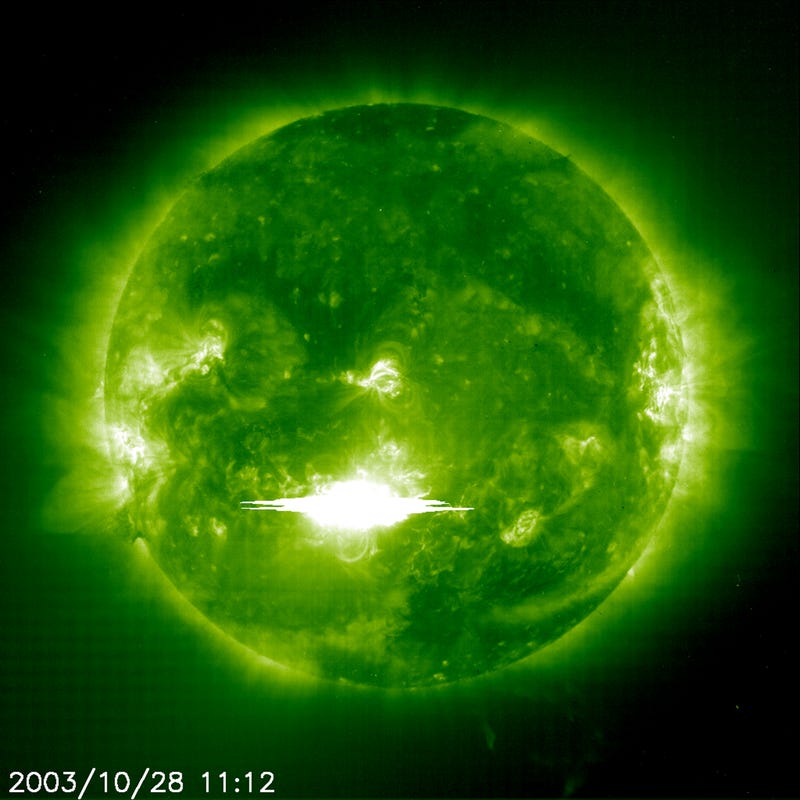
One of the most powerful flares measured with modern instruments took place during a solar maximum in 2003. It was so large it maxed out our satellite sensors, which registered an X-28 (28 types larger than an X-1 flare, which itself is 10 times greater than an M1 flare). Here’s what that event looked like:
Despite observing flares for over a century, scientists still aren’t totally sure what causes the Sun to erupt. We do know that flares have a lot to do with disruptions in the Sun’s powerful magnetic field, which oscillates over the course of an 11-ish year solar cycle.
“Solar storms originate in magnetic features that erupt from the surface of the sun,” explained space weather scientist Joe Gurman, speaking to Gizmodo from NASA’s Goddard Spaceflight Center. “We call these active regions, or sunspots. When they’re big and ugly, that’s an indication that the magnetic field is changing rapidly. And when the magnetic field changes rapidly, that appears to be the cause — or related to the cause — of solar activity.”