
I am a very picky person about my shoes, even more than my wife.
When I find a pair of shoes that I like I wear them until there is nothing left of the sole.
I am finally coming to realize that I am waiting way too long on replacing my shoes.
The reality of the matter is, when I replace my shoes before they fall apart my back problems and tired feet just went away.
Did you know that as a general rule, most running and walking shoes last up to 500 miles. Lets take a closer look at this:
Based on several different studies I have found the average American walks roughly 4000-6000 steps per day and has an average stride length of 2.5 feet
If you are a completely sedentary person and spend the majority of your day at a desk your total steps per day may be closer to 2000
This means that you walk roughly 1.4-2.8 miles per day.
Keep in mind that this is normal day-to-day activity and does not include any additional exercise.
At this rate a pair of shoes should last you somewhere in the neighborhood of 312 days.
How and where you use your shoes could seriously alter that number.
For example, pavement is much harder on your shoes than a rubberized track, a dirt trail, or gravel.
Also keep in mind that shoes with an EVA midsole tend to wear down faster than shoes with a midsole made of polyurethane.
More Than A Guessing Game
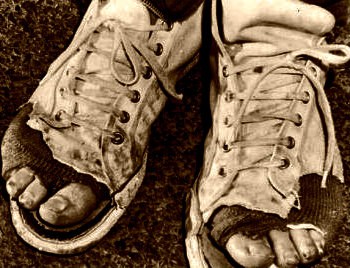
If you are waiting until you walk right out of them before you decide it’s time to replace your shoes… you are waiting entirely too long.
Your feet are the only things that keep you moving and they need to be kept in top shape and protected at all costs.
That old pair of boots may be comfortable and “broken in” but waiting too long to replace your shoes you could end up doing more harm than good.
Below are three guides that will help you to determine when its time to toss your old sneakers to and pick up a new pair.
The Press Test:
To determine if the midsoles of your shoes are compressed and are not doing their job by providing a proper cushion and shock absorption, do the press test.
Using your thumb, push on the outsole upward into the midsole. With new shoes, it should be easy to see the midsole compress into lines or wrinkles. As the shoe wears down, the midsole compresses less with the same amount of pressure. When the midsole shows heavy compression lines and the press test reveals a minimal amount of compression, there is little or no cushioning left and it is time to replace them.
When Looks Matter:
Don’t worry about how dirty they are. Being dirty just means that they are well used, and that’s a good thing. What you need to be concerned with first and foremost is general wear and tear.
Take a look at your shoes. Are the heels stretched out? Are places on the outsoles worn down?
Can you see how the shoes have molded to your foot? Is the leather rubbed through or torn?
These are all signs of excessive wear.
If Your Dogs are Barking, You Should Listen:
Your body will know when there is little or no cushioning left in your shoes and it will be sure to tell you.
If you notice any aches or pains in your feet, legs, knees, hips or back after you’ve worn your shoes, it’s a good sign that you need a new pair.
Other signs include friction or blisters in unexpected places, which means your shoes have stretched and your feet are moving around too much inside the shoes.
Get the Most Out Of Them:
Pinching pennies? Or just really like that pair of boots?
Below are a few tips to help you get the most wear out of your shoes
Rotate Two Pairs of Shoes:
It’s a good idea to have two or three pairs of walking or running shoes that you can alternate using. You’ll find they’ll last much longer.
Also, switching out shoes allows them ample time to dry between wears, which can help keep you from getting fungal infections like athletes foot and will help stem a foot odor problem.
Take Them Off The Right Way:
If you take off your shoes properly—by unlacing them and removing them with your hand instead of kicking your shoe off with the other foot and launching them across the room—they’ll last much longer.
Use Them For What They Were Intended
Wearing your expensive running shoes around the house or around town instead of sticking to the track with them will wear them down more quickly. Exercise shoes were built to be used effectively for exercise. You wouldn’t wear a pair of football cleats to a black tie affair would you?
Save your running or walking shoes for exercise.