


A Step-by-Step Guide on How to Create Your Own Price Binder
1. Figure your grocery list out; base it on what you regularly eat.
2. Transfer your list to a notebook and allot at least half a page for every grocery item you have.
3. Create a table of contents (for easy searching).
4. Go to every store you normally shop at and look for the items you’ve listed.
5. Take note of their prices. There are bound to be differences from retailer to retailer.
6. Buy from the cheapest.
7. Now that you know what each of your items cost, you can use that data to plan your meals according to price.
8. This precision planning allows you to stay in budget every time.
Over the years I have come to realize that, as silly as it sounds, grocery shopping is a very personal task.
Everyone has their own ritual, their own philosophy, and their own opinions on the most efficient, effective and affordable way to shop.
Some people swear by couponing, some people buy in bulk, some people wait for sales, and still others even buy groceries online.
Well, a couple of months ago I decided it was time for my grocery routine to get an overhaul.
My husband and I had recently laid out a detailed budget for ourselves and I was bound and determined to stick to it.
However, in the past this had proven difficult. I had been consistently budgeting $200 per month for our food and non-pharmacy-related home products (toilet paper, soap and the like). It seemed like a reasonable amount to me, but with every grocery trip I consistently surpassed the budget and became more and more frustrated.
I tried coupons and store membership cards but as my diet changed to include less and less processed foods coupons became less and less valuable.
Then, I read an online article about a family of 6 who ate all natural, organic, and unprocessed food on a grocery budget of $180 per month (food only, no home goods).
I found more information about the family and learned that they had overhauled their food budget after simplifying their life and reading “The Complete Tightwad Gazette”, a book made up of six years worth of newsletters on frugality and saving money.
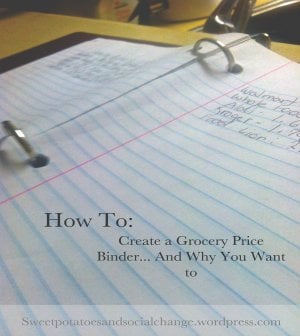
Intrigued, I rented the book from the library and got reading. What it recommended was creating a grocery price binder that took the items you most frequently bought and listed the prices of the item at all of your area stores.
Not only does this help you clearly see what product is cheapest in what store, but it also gives you baseline information for determining a good sale when you see one.
I’m not going to lie, going around and getting the information was time consuming, as was putting together the binder. However, in the end it only took a couple of days and it was beyond worth it! This is by far the most helpful money saving tip I have ever received.
Here is what I did:
First, I made a page for each item that I was including in the binder. Then I went to the five stores I most commonly shop at (Whole foods, Kroger, Food Lion, Walmart, and Aldi) and found the best price/unit for each product at each store.
I listed the prices by store under each item and stored the pages in the binder. I also made a table of contents, which is very important because it makes finding the items much quicker. Here is an example of what a page looks like:
Frozen Green Beans:
Walmart: $0.98/12oz
Whole Foods: $2.49/32oz
Aldi: $1.49/16 oz
Kroger: $2.17/32 oz
Food Lion: $.97/16 oz
So, that is all fine and dandy but what do you do with this information once you have it and how does it change the way you shop and eat?
There is a lot to be gained through this process but here are the top three uses that I have found for my price binder:
1. Price your food by the meal:
Having a list of how much each of your ingredients costs makes it very easy to decipher how much you are spending per meal and which meals are cheapest to make. This means that you can stay within your grocery budget simply by planning your meals wisely. For example: my “frugal chicken recipe” which contains 1 can of diced tomatoes 2 chicken breasts some herbs and some optional rice costs my only $2.87 to make for two people.
Making hamburgers, on the other hand, costs over $8 when you include the ground beef, onion, cheese, and the sweet potato fries we usually eat (this doesn’t even include the condiments).
So, after making the price binder it became clear that not all meals are created equal and in order to stay within our budget we were going to have to balance our cheap meals with our more expensive ones. (Realizing how much cheaper meals are at home, compared to going out, has also been a good take-out deterrent as well)
2. Shop the ingredient not the store:
Going through this exercise also helped me realize how much convenience was costing me. The concept of the all-encompassing grocery store has bred within us this notion that we have no other options but to buy all of our food in one place.
I distinctly remember thinking to myself on multiple occasions as I walked the store aisles, quickly checking items off my list, “ Well, I guess it might be cheaper to buy some of these things at a different store, but probably not by much! I mean, once you factor in time and gas I doubt its even worth it at all…” WRONG!
It is completely worth it. Need some proof? Borax, a simple ingredient I use in both my laundry detergent and dishwasher detergent is $4.79 at both Kroger and Food Lion, but at Walmart it is only $3.38 that is a difference of $1.41… that means that if I buy one box of Borax every month I could either save or spend an extra $16.92/ year on this ONE ingredient, depending on where I shop.
Now, imagine the difference to be made in your budget if this was true for all of the ingredients on your shopping list… Yes, I do have to shop at multiple grocery stores. Yes, grocery shopping does take me longer. However, it is far less painful then it ever used to be because now I am ALWAYS within my budget!
3. Avoid Surprises!
Last, but not least, knowing what your food costs before you go to the store means that there are no surprises at the cashier’s station. It means I can accurately budget for food, I can eat healthy food without feeling guilty or spending more, and I can take advantage of good sales when they actually arise. That way, the only surprises on a grocery trip are good surprises!
How do you think a price binder could help you? What are your tips on eating healthy on a budget?