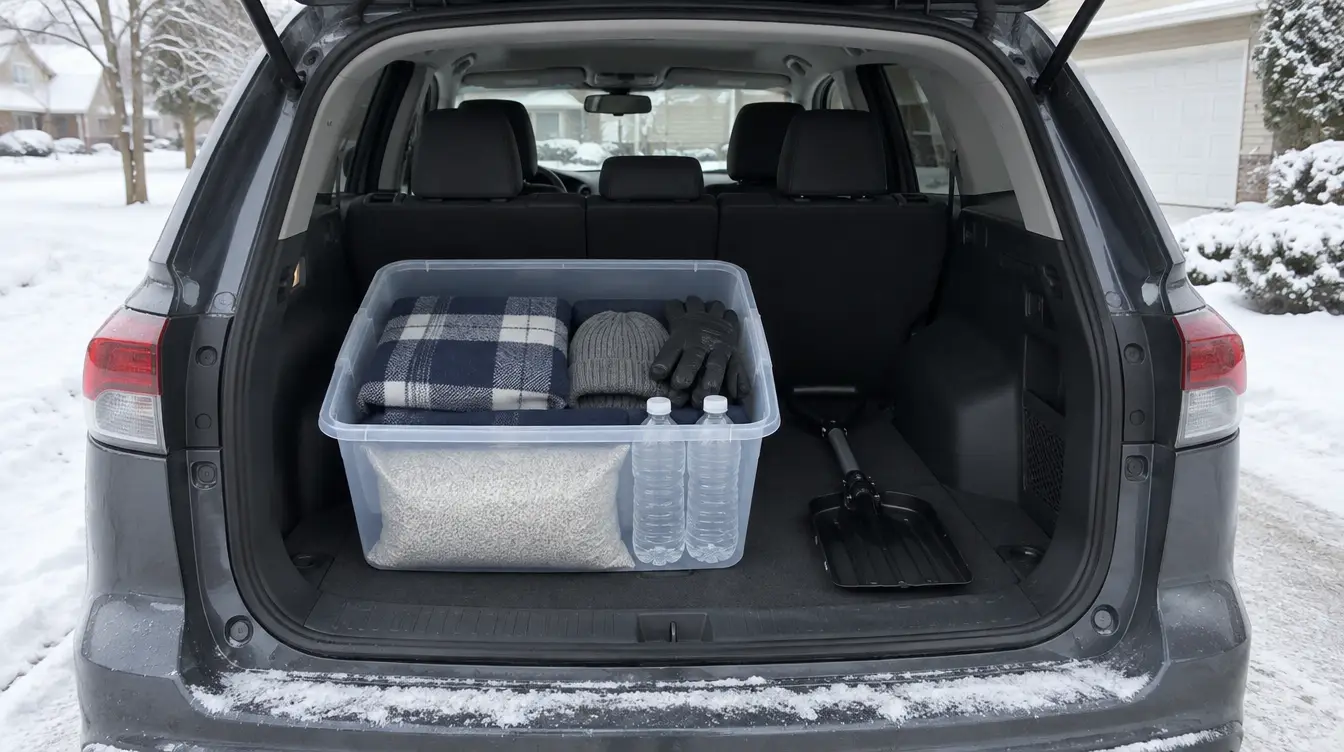

Most of us have a winter car survival kit that’s really a pile: a scraper, an old blanket, maybe some cables. That’s stuff, not a system. And the night your car won’t start at a dark rest stop is the night you find out which parts are missing.
At a Glance: Winter Car Survival Kit
- What goes in it: a way to start the car, a way to dig out, warmth for everyone inside, and a way to be seen.
- Test the battery first: at 0°F a car battery has about half its power, right when a cold engine needs more.
- Jump starter or cables: cables need a second car. A lithium jump starter doesn’t, but it won’t charge below 32°F.
- If you get stuck: stay with the car, keep the tailpipe clear of snow, and run the engine 10 minutes each hour.
Survival Life earns a commission if you buy through the Amazon links on this page, at no extra cost to you. It doesn’t change what we recommend or the order we recommend it in, and the cheapest option gets the same attention as the most expensive.
Check the Battery Before You Pack Anything
Here’s the part most kit lists skip. The best trunk kit in the world doesn’t help if the car won’t turn over in the driveway.
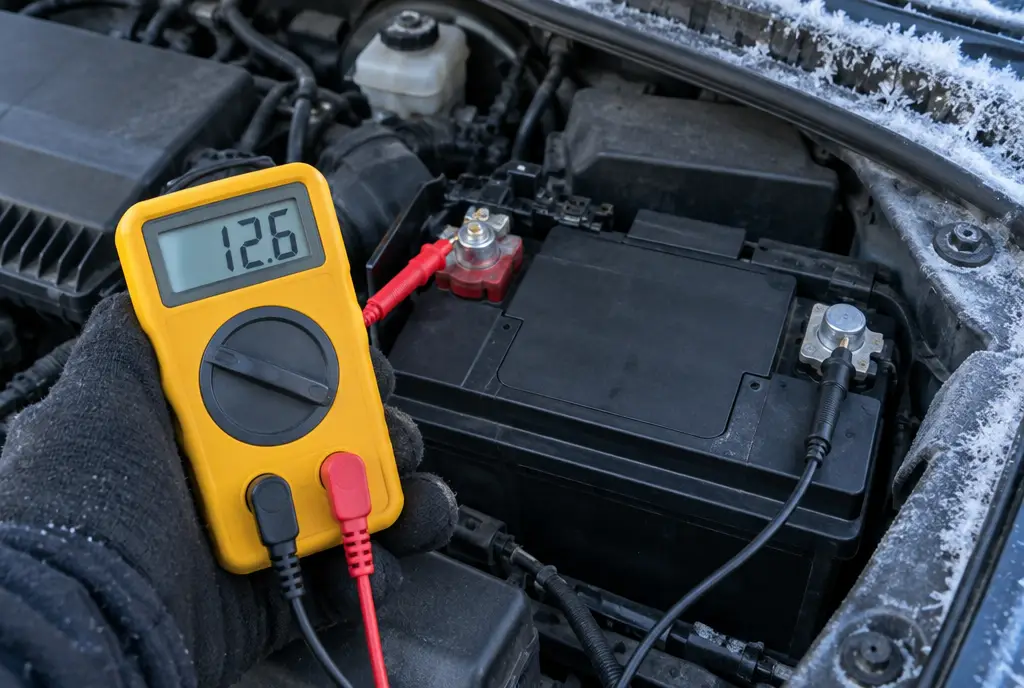
Cold slows the chemistry inside a car battery.
A typical lead-acid battery gives about 80% of its rated power at 32°F and about 50% at 0°F. Meanwhile, cold oil makes the engine harder to crank. So the battery has less to give right when the engine asks for more.
The 10-minute battery check:
- Let the car sit 4 hours or overnight. A reading right after driving is falsely high.
- Read it with a $10 multimeter. Touch red to the + post and black to the − post. Under 12.4 volts means the battery is low and needs a full charge before you can judge it.
- Get a load test. Auto parts stores will load-test it, and many do it free while you wait. A voltmeter shows charge. A load test shows whether the battery can still deliver power.
- Clean the posts. White or green crust on the terminals blocks current. A wire brush and a tight clamp fix it.
If the battery fails the load test or is 4 to 5 years old, replace it now. A battery that limps through October quits in January.
Jumper cables or a jump starter?
Jumper cables cost less and never need charging. But they need a second running car, and a second car is the one thing you can’t count on at 2 a.m. on an empty road.
A lithium jump starter starts the car alone. The catch is charging.
The NOCO GB40, for example, works down to −4°F but only charges between 32°F and 104°F. So a pack that rides in a frozen trunk all winter can’t top itself up. Bring it inside once a month, charge it, and put it back.
As an Amazon Associate, Survival Life earns from qualifying purchases.
Good
$20–$30
Energizer 16-ft jumper cables
16 feet reaches car to car without parking nose to nose. Copper-clad aluminum, not solid copper, and you still need a second car.
Better
$90–$110
NOCO Boost GB40 jump starter
No second car needed. Rated for gas engines up to 6.0L and diesels up to 3.0L, and it doubles as a phone charger. Needs charging indoors in winter.
Best
$120–$140
Clore Jump-N-Carry JNC660
A shop-grade pack with a 22Ah battery, 1,700 peak amps, heavy #2 cables and a built-in voltmeter. Biggest and bulkiest of the three.
Own a Hererod jump starter? Stop using it
Owners of Hererod jump starter and power bank models PW40 and EW40 have been told to stop using them now because the lithium batteries inside can explode and catch fire. There have been 16 fire reports, 7 with property damage. About 12,500 were sold on Amazon, eBay and CarKart from August 2024 to August 2026, and the maker hasn’t agreed to a recall.
The PW40 has “PW40” printed on the front and can inflate tires. The EW40 has no model number on it.
Don’t put either one in the trash or a store battery bin. Call your local household hazardous waste site first and ask if they take damaged lithium batteries.
The Winter Car Survival Kit: Your Trunk List
Pack it in two places. The few things you need without getting out of the car ride up front. Everything else goes in one bin in the trunk, on top, where you can grab it without unloading groceries.
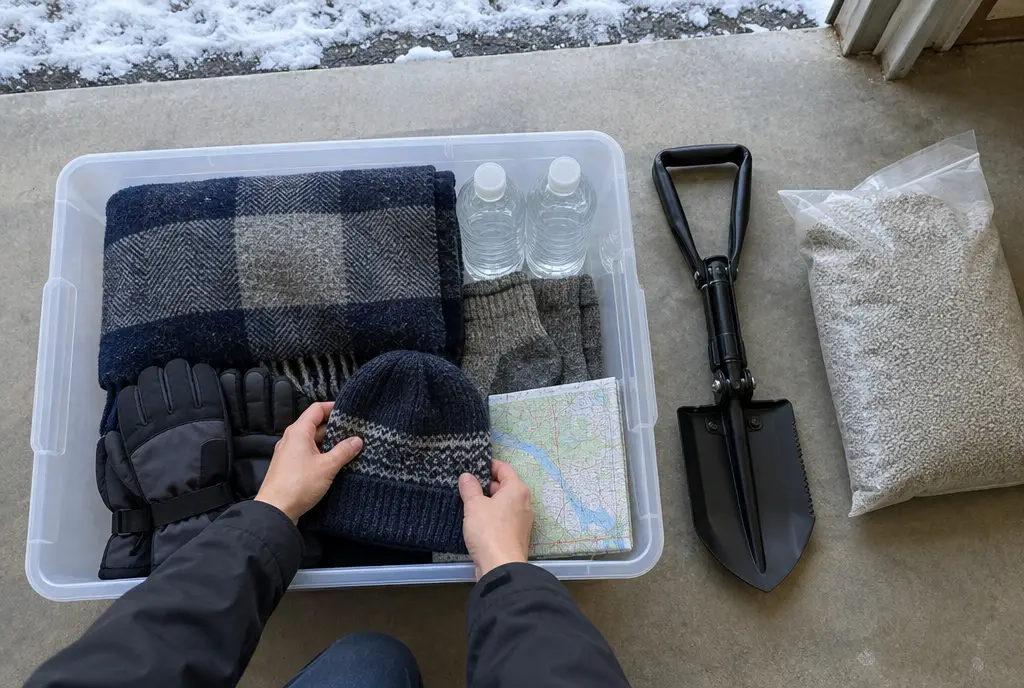
Linked items in this table are Amazon paid links. Anything you already own works just as well.
Winter car kit, packed by where it rides
| Item | How many | Why it’s there |
|---|---|---|
| Within reach of the driver | ||
| Ice scraper and snow brush | 1 | You can’t drive what you can’t see out of. |
| Phone cable and charged power bank | 1 each | Cold drains phones fast, and the phone is how help finds you. |
| Headlamp with spare batteries | 1 | Keeps both hands free for chains, cables or a shovel. |
| Trunk: start the car and dig out | ||
| Jump starter or jumper cables | 1 | A weak battery can’t turn a cold engine over. |
| Compact shovel | 1 | Clears snow from the tires and the tailpipe. |
| Traction mats or non-clumping kitty litter | 1 pair or 1 bag | Gives spinning tires something to bite. |
| Tire pressure gauge | 1 | Pressure drops as it gets colder. Check it monthly. |
| Trunk: stay warm | ||
| Wool or fleece blanket | 1 per person | Holds heat even when damp, unlike cotton. One from the house is fine. |
| Mylar emergency blanket | 1 per person | Weighs almost nothing. Wrap it over the wool blanket. |
| Hat, gloves, wool socks | 1 set per person | Hands and feet go numb first. |
| Chemical hand warmers | 2 per person per day | Heat that doesn’t need the engine running. |
| Water and high-calorie snacks | 1–2 liters and 2,000 calories per person per day | Leave headspace in bottles so they can freeze without splitting. |
| Trunk: get seen and get help | ||
| LED road flares or reflective triangles | 3 | Warns traffic before it reaches you. |
| Bright cloth or bandana | 1 | Tie it to the antenna so plows and rescuers spot the car. |
| First aid kit and 3 days of daily meds | 1 | A delay can turn into an overnight. |
| Paper map of your area | 1 | Works with no signal and no battery. |
With kids or pets: Add diapers and wipes, formula with measured water, and a leash, bowl and a day of pet food in a zip bag.
Want the small stuff that rides up front all year? Our list of survival gear that fits in a glove box covers it.
Winterize the Car Itself
The kit gets you through a bad night. The car work keeps you from needing it. Plan about 90 minutes on a weekend in October or November.
- Tires: Michelin’s guidance is to switch to winter tires once daily temperatures stay below 45°F, and to expect about 1 psi lost for every 10°F drop. Set pressure cold, using the sticker on the driver’s door, and recheck monthly. The stick gauge already in your glovebox works fine. If you don’t have one, a digital tire pressure gauge reads to about 1 psi and is small enough to add to your next Amazon order (paid link). Replace winter tires at 4/32 inch of tread. (Some cars also watch the spare’s pressure, so check that one too.)
- Washer fluid: Drain the summer stuff and refill with a winter-rated fluid. Summer fluid can freeze on the glass at highway speed.
- Coolant: With the engine cold, check that the reservoir is at the full line. A coolant tester costs a few dollars and tells you how cold your mix can take.
- Wipers and lights: Fit winter blades. Then walk around the car at dusk and check every light. Clean cloudy lenses.
- Locks and seals: Wipe door seals with silicone spray so the doors don’t freeze shut overnight.
Running out of fuel is the other easy one to prevent. Keep the tank above half all winter. A fuller tank gives you more hours of heat if you’re stuck.
Stuck in Snow: What to Do in the First Hour
Panic makes people do the two dangerous things: walk off into the storm, or sit in a running car with a buried tailpipe. Decide now, while you’re calm, so you don’t have to decide then.
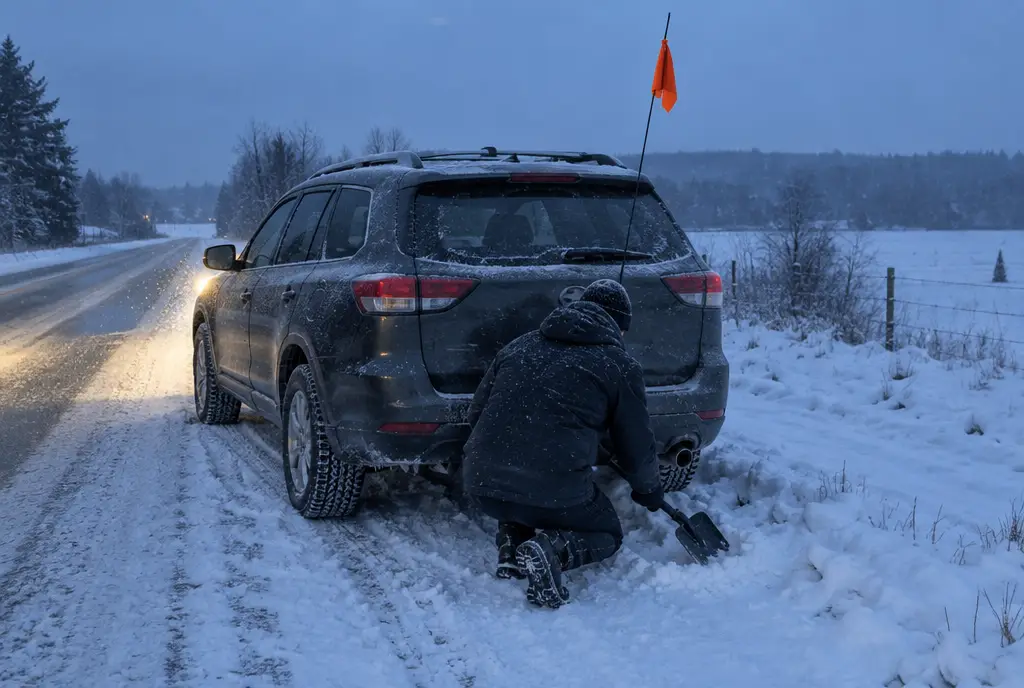
- Stay with the car unless you can clearly see a building close by. A car is shelter, and it’s much easier for searchers to spot than a person.
- Call or text for help while your phone still has charge. Give your road, direction and the last exit or mile marker you passed.
- Clear the tailpipe before you run the engine. Snow packed around it can push exhaust into the car, and carbon monoxide has no smell.
- Run the engine about 10 minutes each hour for heat, with a window cracked open a little. Check the tailpipe again each time you start it.
- Get seen. Tie the bright cloth to the antenna, set out flares if it’s safe to step out, and turn on the dome light at night when the engine runs.
- Stay warm without sweating. Layer up, share blankets, and move your arms and legs. Wet clothes from shoveling pull heat out fast, so pace yourself.
This is the drill your family should know without you there. Read these six steps out loud on the next long drive, and ask the kids where the blankets live. If you want to go further, our winter storm survival guide covers the house side.
Common Mistakes With Winter Car Kits
- Packing the kit but never testing the battery. A car that won’t start strands you in your own driveway, and no blanket fixes that.
- Leaving a lithium jump starter to freeze all season. It can’t charge below 32°F. Bring it in monthly, or it may be flat when you finally need it.
- Burying the kit under everything else. If you have to unload the trunk in a blizzard to reach the shovel, you won’t. Keep it on top.
- Running the engine without checking the tailpipe. A drift that builds while you wait can block it. Check before every start.
- Buying a prebuilt kit and never opening it. Open it and see what’s actually inside. Then add a blanket and hand warmers for every seat.
- Never practicing. “Just theory, never drilled it” is how most families stand when the car stops. Ten minutes in the driveway changes that.
Frequently asked questions
A way to start the car, a way to dig out, warmth for every person, and a way to be seen. That means jumper cables or a jump starter, a shovel and traction aid, a blanket and hand warmers per person, water and snacks, a charged power bank, and flares or triangles.
Yes, but charge it indoors. Lithium jump starters like the NOCO GB40 work down to −4°F but only charge between 32°F and 104°F. Bring it inside once a month to top it up.
About 10 minutes each hour, with a window cracked open a little. Clear snow away from the tailpipe before every start, because a blocked tailpipe can push carbon monoxide into the car.
Both. Keep the scraper, phone charger and headlamp within reach of the driver. Put the bulky gear in one bin on top of the trunk load, so you can grab it even if the trunk is hard to open.
Let the car sit 4 hours, then check it with a multimeter. Under 12.4 volts means it needs a charge. Then get a free load test at an auto parts store, and replace the battery if it fails or is 4 to 5 years old.
Do one thing today
Tonight, go out to the car with a flashlight and find three things: the scraper, something warm for every seat, and a way to start the car without another vehicle. Whatever you can’t find goes on this weekend’s list.
Quick poll: The last time your car battery died, what got you going again?
What happened the last time your battery died? Tell us in the comments.