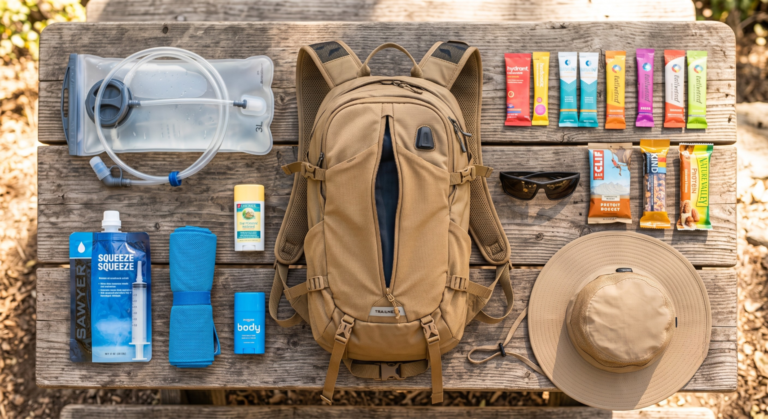



A few energy bars, some water should and an emergency blanket should be all you need to survive a night on the trail right?
Wrong!
An emergency blanket is great to have, but make sure you realize that it is not a fool proof way to stay warm. Make sure that you understand its limitations.
In first aid these blankets are used to prevent or counter hypothermia. They do this by utilizing three key methods of heat retention:
-The airtight foil reduces convection
-Heat loss caused by evaporation of perspiration, moisture or blood is minimized by the same mechanism
-To a small extent the reflective surface inhibits losses caused by thermal radiation.
These “space blankets” have been marketed as emergency or survival blankets for years and while they can save your life they do suffer from some fatal flaws that are rarely ever discussed.
The main thing that most people fail to realize is that emergency blankets only serve to reflect heat back to the body. Unlike a wool blanket, the emergency blanket does not have any insulation to trap air and keep you warm.
There are 5 ways in which the body loses heat and an emergency blanket is really only useful against one of them:
Convection
When the wind blows against skin or wet clothing, the cooler air will literally strip body heat from you. This is what is commonly known as wind chill will cause you to become much colder.
While your space blanket will effectively block the wind from touching your body, you will still lose a good deal of heat as it passes over the exposed blanket.
Conduction
Heat will be lost through contact with any surface that has a lower temperature than that of your body.
If you wrap yourself up in an emergency blanket and then sit on the ground, your skin will be in contact with the blanket which then touches the ground.
You will immediately begin leaching your body heat into the ground. This falls back to having proper insulation. The only way to lessen or prevent this is to keep your rear end insulated from the frigid earth. Put down a bed of pine needles, dead leaves, or if you have it, foam padding. If you end up stuck outside on a cold night this will make it just a little more bearable.
Radiation
Heat is lost through radiation from all over the body. As we are warm blooded, our bodies work to maintain a 98.6 degree core temperature. This is the least significant factor of heat loss. Your clothing, hats and gloves all serve to block heat loss from radiation.
This is what space blankets were designed for and is the most effective method by which they will protect you.
Evaporation
Heat is lost through the body’s natural cooling system (perspiration) which evaporates from the skin and clothing wet with sweat, melted snow, rain, stream crossings and more.
Even in the coldest weather, you can start to sweat with enough exertion. Your body will naturally need to regulate its temperature but a strong cold wind
A space blanket is completely water proof. This is great for keeping water out, but the problem is that any water inside the blanket has nowhere to go.
If you spend a night under an emergency blanket, you are likely to start the morning of with soaking wet clothes, leaving you susceptible to hypothermia.
Not a good start to the day in my book.
Respiration
The last way in which heat is lost is through respiration (breathing). As you exhale your breath carries away body heat. You can prevent much of the loss by covering your mouth and nose with a scarf or a mask. You may need to stop, stay in one sheltered place and limit your heat loss from heavy breathing while trekking through the cold.
Emergency blankets may have some serious faults with their intended purpose but what they lack as a blanket they more than make up for in alternative uses. Namely:
-A signal for rescuers to find you
-A way to catch and store rain water
-A waterproof poncho
-A trail marker so that you don’t end up walking in circles
-A wind break for your shelter
-A heat reflector if you build a camp fire
Having an emergency blanket is essential to have in your gear.
In fact, not having at least one of them is stupid.
They take up no space, weigh next to nothing, and typically cost less than $5.00.
Just don’t make the mistake of traipsing off into the woods with only a light jacket and a Mylar blanket
That false sense of security can get you killed quickly.
Make sure that you know what to expect when you are leaving and pack more than you need.
Can you think of any other uses for an emergency blanket?
How about alternative methods to keep warm in a survival situation?
Leave a comment below and let me know!