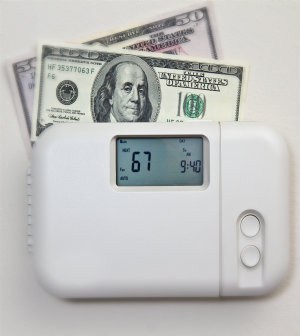

In the winter, we do everything we can to keep warm. Bundling up, wearing extra socks, using space heaters etc.
The most common thing to do however, is step up to your thermostat and click it up a few notches.
In a few minutes you will be a few degrees more toasty.
It’s easy to do and most of us think very little about the consequences.
What is it really costing you?
Heating bills vary greatly depending on house size, climate, insulation, fuel choice and fuel prices.
But it is easy enough to find some averages.
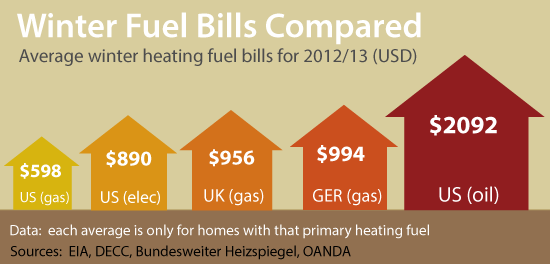 In the graph above we have five typical winter fuel bills, converted to US dollars at average exchange rates over the last winter. These costs may include a little energy used for hot water or cooking, but they are mostly about heat.
Winter Fuel Bills Compared
In the winter of 2012/13 the average American home using natural gas spent $598 on fuel over the heating period.
British homes using natural gas spent £607 ($956) over the same period, while German homes using gas spent €770 ($994).
The American homes actually used more, because they have big houses, but the bill works out lower because they also have very cheap natural gas prices.
US homes using oil (mostly in the North East) have huge heating bills, both because they use a lot of energy and because fuel oil is expensive
Living in Texas, and being “hot natured,” I rarely ever turned on my heater…
Until this past winter!
Many of you may know that I’ve lost quite a bit of weight recently and with it, the comforting insulation that protects me from the cold.
Now, if it’s a little frosty outside, I’m bundled up with a sweater, coat, and 2 pairs of socks!
So, needless to say, I am not looking forward to my monthly heating bill this year.
But what if you could save money on your heating this year, without having to rip your thermostat off the wall?
I can’t take full credit for this article, My buddy Damien over at reThinksurvival.com brought this nifty device to my attention on one of his recent posts.
Click here to see the original article.
I was so excited about saving money on my heating bill that I jumped at the chance and impulse-bought this Dundas Heat Keeper Kit. It happened to show up the next day and I was about to install it when I immediately realized it wasn’t going to work THAT easily because I needed to purchase two dryer vent ducts. All these vent ducts do is connect your dryer to the duct that goes outside the house.
Anyway, I went with two five foot long ducts so that I could extend from the bottom of the dryer (where the duct outlet is) up to above the dryer where I connect it to the Dundas Heat Keeper Kit and then back down to the floor again where it connects to the outside duct. If you’ve ever messed with dryer ducts you’ll understand. I needed two because my dryer happened to connect directly to the outside duct, you, however, may be able to get away with only one additional dryer vent duct depending on what you have in your home already… pull the dryer out and look.
The setup is really simple: connect a vent duct from the dryer to the heat keeper and then connect the other end of the heat keeper using the second vent duct to the outside vent. They provided two “clamps” that were nothing more than large zip ties for connecting the dryer ducts to the heat keeper which worked well enough but I wouldn’t have called them clamps. I also had to purchase two additional 4″ metal duct clamps as well but you may not need to. Here’s what it looks like when completed:
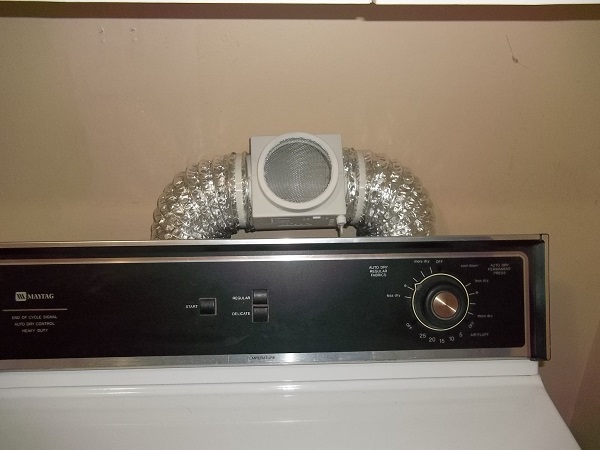
I briefly thought about velcroing it to the cabinet above but I figured it rested well enough atop the dryer and “the boss” didn’t complain other than to say after the first time I used it “It’s not very warm!” But, in my defense, I just started using it. Later on it warmed up. Speaking of which, I also immediately turned the laundry room into a sauna as evidenced by this picture of the now fogged-up exterior door:
It just so happens I fogged-up the bathroom mirror something awful too as the master bath is adjacent to the laundry room. Anyway, the important question is: how well did it heat the house?
Well, the first test is how much warmer the house feels…
Continue reading Damians review on rethinksurvival.com