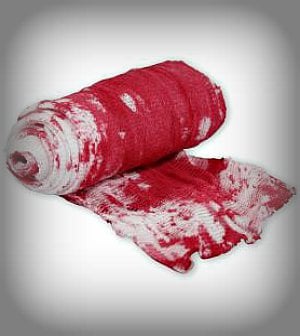

One of the leading preventable causes of death on the battlefield is bleeding to death from leg and arm wounds.
These are typically caused by small arms fire or fragmentations from RPGs, IEDs, or grenades.
You can potentially experience similar injuries in a survival situation from the same things but also from flying debris during a tornado/hurricane, falling onto sharp objects, or a compound fracture. If you don’t control the bleeding immediately, you will die.
In general, if there is any clothing or foreign objects still in the wound you DO NOT want to take them out because you could possibly injure yourself further.
1. Pressure dressings. Unless there is an amputation, a protruding object or an obvious artery severed (bright red, pulsing flow of blood), this would be my first choice of treatment for a large wound. The Israeli Battle Dressing Bandage is one of the most popular and easy to use pressure dressings there is.


You take it out of its vacuum sealed, sterile packaging; apply the gauze side on the wound; wrap the loose end through the pressure bar and start reverse wrapping to the end of the wrap then secure it. The pressure bar is on the opposite side of the gauze, and by bending it back on itself, you are applying more pressure directly on the wound than wrapping alone would apply. If you end up using different materials, tie all knots directly over the wound to apply more pressure to it. The point of any pressure dressing is simple – apply enough pressure until the bleeding stops.


2. Quik Clot. Quik Clot Gauze contains a mineral substance called kaolin that reacts with blood to essentially “weld” shut arteries. It’s designed for only severe wounds where you can’t really put a tourniquet – armpit, groin, etc. You take it out of its package and actually stuff it inside of the wound as you unravel it and then cover it with another type of dressing (i.e. a pressure dressing).
Remember, this is only for very extreme wounds and only doctors should be removing it because removal could possibly reopen the sealed artery. When Quik Clot first came out, it was only in its powder form in a bag. I’ve heard horror stories of Soldiers opening these bags and the wind blowing the powder into their face/eyes reacting with the sweat to cause severe burns and even blindness. If you have any of the powder types of Quik Clot, I suggest investing in the gauze form to avoid unintentional contact. Also, this has a specified shelf life so keep that in mind while trying to buy some.

3. Tourniquets. Tourniquets are usually the last option but can easily become your first choice – amputation, protruding objects, arterial bleeding, etc. You can make tourniquets out of just about anything. However, I suggest purchasing the C.A.T. (Combat Application Tourniquet) by North American Rescue. Every Soldier that deploys is issued at least one of these. I have 3 of them – 2 in my bug out bag and 1 in my glove box. If you know what you’re doing, you can apply these to yourself with one hand. Any tourniquet you use needs to be 2” above the wound or joint.
For example, if your arm is amputated 1” below your elbow, the tourniquet needs to be 2” above your elbow. If you end up making your own tourniquet, you need two strips of material and a windlass. A windlass is anything that can be used to tighten the tourniquet – a stick, pen, rod, etc. Tie a knot in your material with the windlass in the middle of it; twist the windlass until the bright red (arterial) bleeding stops; secure the windlass with your other piece of material.
You can craft makeshift pressure dressings and tourniquets if you’re desperate, but why put yourself in that situation? For less than $100 you can buy several of each and be even more prepared for whatever may come your way. If you do have to make your own though, make sure that the material you use is at least 1” wide – any less than that and you risk doing more harm than good (aka use your belt instead of your boot lace).
For severe wounds, all of the above things are mostly temporary fixes until you can make it to a hospital or some other sort of medical professional. For example, if a sign post goes through your leg during a hurricane and you put a tourniquet on it, you could probably survive several days before eventually making it to a hospital that is up and running.
via 3 Efficient Methods to Control Bleeding from Extremities — 72hrbugoutbag.com.