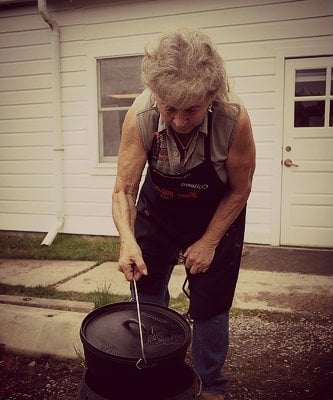

Part of being a Prepper is having alternative means of doing things. As far as cooking goes, Dutch Oven cooking can be your alternative means for making food for your family should there be no normal means to do so. A Dutch Oven can cook almost anything you can cook in your kitchen oven, but I think it does even better! Here is a little history first before we dive into other topics…
Dutch Ovens originated in Holland as Iron Pots cast in a dry sand mold. In the early 1700s an Englishman named Abraham Darby traveled to Holland to inspect the manufacturing process. He returned to England and improved the process with better molds and sold many Dutch Ovens to the American Colonies. It has also been suggested that Dutch traders or settlers had named them as well.
These days, the name “Dutch Oven” can be seen about everywhere on varying types of cookware. Traditionally though, a Dutch Oven is made of cast iron and sits on three legs to keep it above the coals. The lid has a rim on it to keep hot coals in place and it has a steel handle to remove it from the heat. Many modern manufacturers produce Dutch Ovens, Lodge being one of the most prominent ones. Cooking pots similar to today’s Dutch Ovens have been in use since around the 7th century. Dutch Ovens last so long they were even willed to children and grandchildren from parents and grandparents. American pioneers and explorers carried Dutch Ovens with them as settlement moved west on the North American Continent. Lewis and Clark, Mountain Men, and Cowboys on the cattle drive all used Dutch Ovens. The Dutch Oven has been continually refined into what it is today. All parts of it were tinkered with until as Goldilocks would say “this one is just right…”
You can purchase a nice model for less than $60.00. We got ours for about that at Wal-Mart a couple of years ago. It’s a Lodge brand in size 12. The number on the top of the Dutch Oven lid indicates its diameter. A 12 inch pot is large enough for most meals you cook in a Dutch Oven and recipes can be easily adapted depending on what size your pot is. The popularity of the Dutch Oven was due to its versatility and that still holds true today. You can boil, bake, stew, fry, roast, etc in a Dutch Oven and then some.
In addition to purchasing a Dutch Oven you may want accessories such as lid lifter, heavy-duty tongs, gloves, and a lid holder. None of those are essential, but make life easier. Lastly, a charcoal chimney makes getting your charcoal started much faster. It’s advisable to cook in an enclosed fire ring or similar structure to minimize the chance of the fire getting away from you.
Start by getting your coals nice and hot using your charcoal chimney and get your Dutch Oven in place. Once they are good and hot, place your ingredients inside and close the lid. You want to place the appropriate number of coals on the top and bottom of the Dutch Oven to get it to the right temperature. Here’s a handy chart you can print out and take with you to the campsite or wherever you are cooking to get your size oven to the right temperature.
Once you have cooked your meal in your Dutch Oven you will want to clean and season it for it to last a long time! The easiest way to do this is to remove all your food scraps, wash the Dutch Oven in hot water, and then apply cooking oil over its entire inside surface. Heat the Dutch Oven so that the oil is absorbed providing a protective layer. If rust appears remove it quickly using an abrasive such as steel wool or a scrub brush to prolong its life. Wash, rinse, and then season as normal.
All in all Dutch Oven Cooking is an easy way to cook just about anything for yourself , family, or friends totally off the grid! You don’t need anything fancy to get started nor a lot of money. My love affair with Dutch Ovens and Dutch Oven cooking began in Boy Scouts and hasn’t stopped yet! Join the club! Speaking of clubs there is probably a Dutch Oven club near you. Here in Texas we have the Lone Star Dutch Oven Society with chapters all over the state. Many of these organizations do demos so you can see and taste what you are getting into before trying it on your own.
Want more? Check out these related contents from our site:
- Make A Zebra Pot Cooking Kit
- Solar Ovens: Cooking on the Bright Side
- [Video Review] Wood Gas Stove…Now We’re Cooking!
Follow us on Facebook, Instagram, Twitter, Tumblr, and Pinterest!
***Disclaimer: The contents of this article are for informational purposes only. Please read our full disclaimer.***
Editor’s Note: This post was originally published on March 11, 2013, and has been updated for quality and relevancy.